



Have you ever wondered if you are ahead or behind your friends when it comes to money? It is a very common question. Most of us want to know if we are doing “okay” for our age. Comparing your savings to a giant pool of other people can be eye-opening. It helps you see the big picture. Whether you are just starting your first job or getting ready to retire, knowing your net worth percentile by age is like having a map for your financial journey.
In this guide, we are going to look at the latest numbers for 2026. We will break down what it means to be in the 50th percentile (the middle) or the 90th percentile (the top). We will also talk about the difference between household net worth percentile by age and individual stats. By the end of this, you will have a much clearer view of where you stand and how to move up the ladder. Let’s dive into the world of wealth and see where you fit in!
What Exactly is Net Worth and Why Does Age Matter?
Before we look at the big tables, let’s make sure we understand the basics. Your net worth is simply what you own minus what you owe. If you have $10,000 in the bank but owe $2,000 on a credit card, your net worth is $8,000. It is a snapshot of your financial health at this very moment. It is much more important than your salary because it shows how much money you actually kept.
Age is the most important factor here because wealth takes time to grow. A 22-year-old might have a negative net worth because of student loans, and that is totally normal! However, a 60-year-old usually has more wealth because they have had decades to save and buy a home. When you ask, “what percentile is my net worth by age,” you are looking for a fair comparison against people who have had the same amount of time as you to build their “money pile.”
Understanding the Household Net Worth Percentile by Age
When experts talk about wealth, they often look at the whole house. This is the household net worth percentile by age. It combines the assets of everyone living together, like a married couple. For many people, their biggest asset is their home. As you get older, your mortgage gets smaller and your house value usually goes up. This is why household numbers tend to look much higher than individual ones.
In 2026, the gap between the “average” and the “median” is still very large. The average is often skewed by billionaires, making it look like everyone is rich. The median (the 50th percentile) is a much better goal to look at. If you are at the median, you are right in the middle—half the people have more than you, and half have less. It is a very honest way to see the “typical” American experience.
How to Use a Net Worth Percentile by Age Calculator
Read more: john elordi
You might want to find your exact rank using a net worth percentile by age calculator. These tools are great because they do the math for you. You just plug in your age and your total wealth. The calculator then compares your number to thousands of other people in your age bracket. It is a quick way to see if you are in the top 10% or if you are still working your way up from the bottom.
When using these tools, remember to be honest with your numbers. Include your retirement accounts, any cash in your pockets, and the value of your car. But do not forget to subtract your debts! A good calculator will show you that even a small increase in your savings can jump you up several percentiles. It is a fun way to gamify your savings and stay motivated to reach your next big goal.
Individual Net Worth Percentile by Age vs. Households
It can be tricky to compare yourself if you are single versus if you are married. This is where individual net worth percentile by age comes in handy. Individual stats focus just on you. This is especially helpful for young professionals or people who keep their finances separate. Generally, individual net worths are lower than household ones because there is only one income and one set of assets being counted.
For example, a person in their 30s might feel behind if they look at household data that includes two high-earners. However, when looking at individual data, they might find they are actually doing quite well! It is all about finding the right benchmark. Whether you are flying solo or part of a team, tracking your progress individually helps you focus on what you can control: your own spending and saving habits.
Detailed Biography of Wealth: 2026 Benchmarks Table
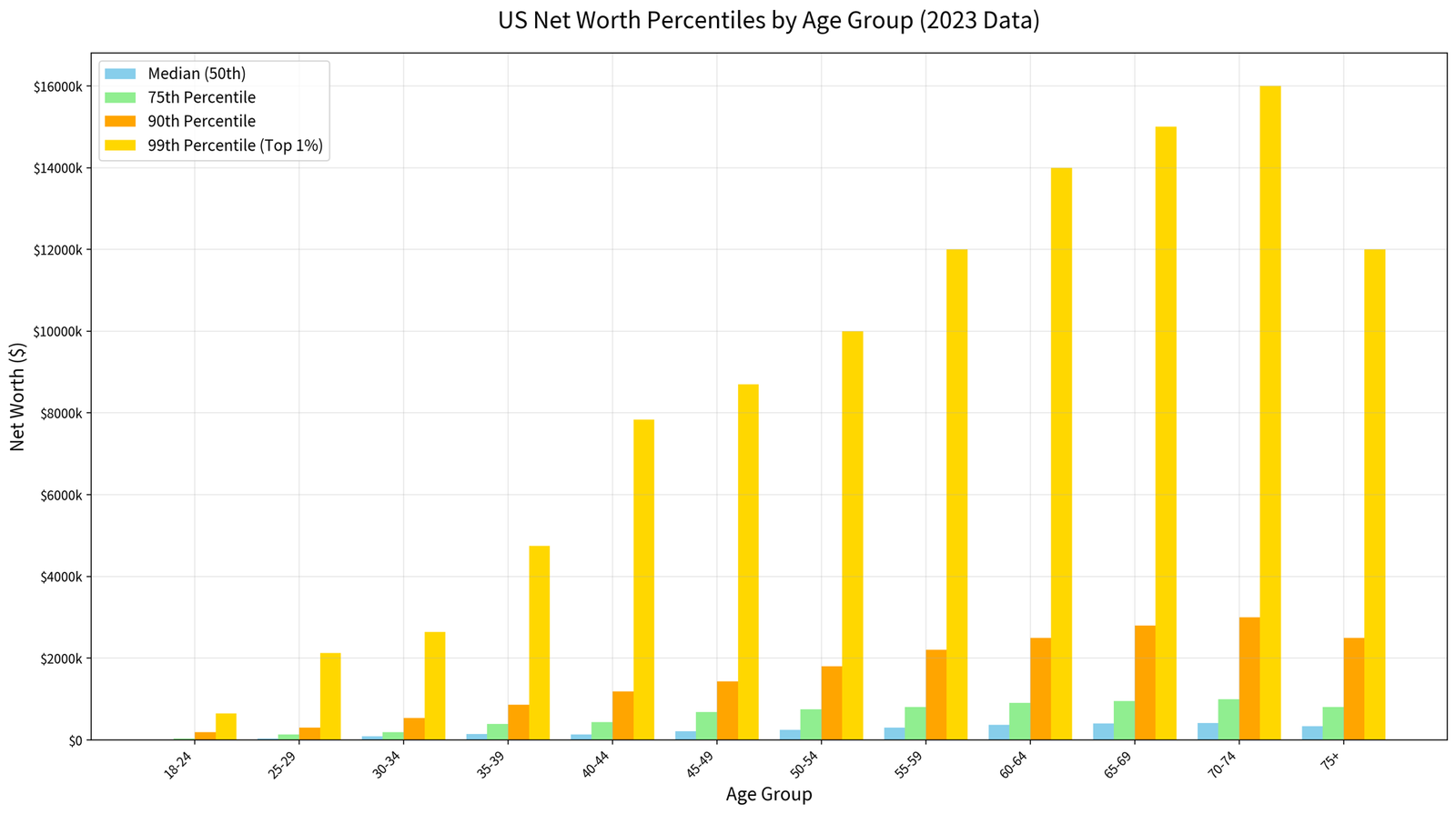
To give you a clear picture, here is a breakdown of where the different percentiles sit in 2026. These numbers represent typical household wealth across different stages of life.
| Age Bracket | 25th Percentile (Starting Out) | 50th Percentile (The Median) | 75th Percentile (Doing Well) | 90th Percentile (Wealthy) |
| Under 35 | $8,500 | $42,000 | $155,000 | $520,000 |
| 35–44 | $32,000 | $145,000 | $410,000 | $1,050,000 |
| 45–54 | $65,000 | $265,000 | $780,000 | $1,950,000 |
| 55–64 | $105,000 | $395,000 | $1,150,000 | $3,200,000 |
| 65–74 | $140,000 | $440,000 | $1,400,000 | $4,100,000 |
| 75+ | $110,000 | $360,000 | $1,250,000 | $3,600,000 |
The Journey Through Your 20s and 30s
In your 20s, your net worth percentile by age might not look very impressive. In fact, many people have a “negative” net worth because of student debt or car loans. Don’t let this discourage you! This stage of life is about building your “earning power.” Your biggest asset right now is your future income. If you can keep your debt low and start a small retirement fund, you will eventually see that number flip to the positive side.
By the time you hit your 30s, the median net worth starts to climb. This is often the decade where people buy their first home. Even though a mortgage is a big debt, the house is an asset that grows in value. If you are wondering what percentile is my net worth by age during your 30s, remember that consistency is key. Even saving $100 a month can make a huge difference over the next thirty years thanks to the magic of compound interest.
The Peak Earning Years: Your 40s and 50s
Most people hit their highest income levels in their 40s and 50s. This is the “sprint” before retirement. During these years, your net worth should be growing the fastest. You are likely paying down your mortgage and seeing your retirement accounts grow. If you check a net worth percentile by age calculator now, you will notice that the gap between the middle and the top starts to get very wide.
This is also the time when “lifestyle creep” can happen. As people earn more, they often spend more on bigger cars or fancy vacations. To stay in a high percentile, it is important to keep your expenses in check. If you can live on less than you earn, you can put more money into investments. This is how the 90th percentile separates themselves from the rest—they own things that make money while they sleep.
Golden Years: Net Worth in Retirement
Once you reach your 60s and 70s, your net worth usually hits its highest point. This is because you have had the most time for your investments to grow. For many, the 50th percentile sits around $400,000 to $450,000. This might seem like a lot, but remember that this money needs to last for the rest of your life! It includes the value of the home and all retirement savings combined.
In the later years (75+), you might notice the household net worth percentile by age starts to drop slightly. This is normal and expected! This is the “spending phase.” After decades of saving, people start using their money to pay for travel, healthcare, and daily living. The goal isn’t just to have the highest number on a chart; it’s to have enough money to live comfortably and enjoy the fruits of your labor.
Factors That Can Swing Your Percentile Rank
Your rank isn’t just about how hard you work. There are many things that change your net worth percentile by age. For example, where you live matters a lot. A $500,000 net worth goes much further in a small town than in a big city like New York or Sydney. Your education level and career choice also play a role. Doctors and engineers often start with high debt but end up in the top percentiles later in life.
Inheritance and family help are also “invisible” factors. Some people in the top 10% had a head start, while others built everything from zero. No matter where you started, the best thing you can do is focus on your own growth. Comparing yourself to others is a tool for motivation, not for feeling bad. Everyone’s financial story is different, and there is always time to make a plan and improve your numbers.
Actionable Steps to Improve Your Wealth Rank
If you aren’t happy with your current individual net worth percentile by age, don’t worry. There are simple steps you can take today to start moving up. First, track your spending. You can’t grow what you don’t measure. Use an app or a simple notebook to see where your money goes. Second, focus on high-interest debt. Paying off a credit card is like giving yourself a guaranteed return on your money.
Third, start investing as early as possible. Even small amounts grow over time. If your employer offers a retirement match, take it! That is essentially free money that boosts your net worth instantly. Finally, keep learning. Read books, listen to podcasts, and stay curious about how money works. The more you know, the better decisions you will make, and the faster you will climb the percentile ranks.
Conclusion
Checking your net worth percentile by age is a great way to see where you stand in 2026. It gives you a benchmark and helps you set realistic goals for the future. Whether you are in the 25th percentile or the 95th, the most important thing is that you are moving in the right direction. Wealth is a marathon, not a sprint, and small choices today lead to big results tomorrow.
Remember, your net worth does not define your value as a person. It is just a tool to help you live the life you want. Take a deep breath, look at your numbers, and make a plan. You have the power to change your financial future. Why not start today? Set a small goal, save a little more, and watch your rank climb over the coming years!
(FAQs)
1. Is home equity included in net worth percentile stats?
Yes, most major reports like those from the Federal Reserve include home equity. This is the value of your home minus what you owe on your mortgage. For many families, this is their largest asset.
2. Why is the average net worth so much higher than the median?
The average is calculated by adding everyone’s wealth and dividing by the number of people. Super-wealthy billionaires pull the average way up. The median (50th percentile) is the middle point and represents a more “typical” person.
3. What is a “good” net worth for a 30-year-old?
In 2026, the median net worth for those under 35 is around $42,000. However, “good” depends on your goals. If you have a positive net worth and no high-interest debt, you are off to a great start!
4. Can my net worth be negative?
Absolutely. If you owe more on student loans, car notes, or credit cards than you own in assets, your net worth is negative. This is very common for young adults and is usually a temporary stage.
5. How often should I check my net worth rank?
Checking once or twice a year is plenty. Your net worth can change based on the stock market or house prices, so checking every day might just cause unnecessary stress.
6. Does my salary count towards my net worth?
No. Your salary is income, not net worth. Net worth is what you keep and own. You could have a very high salary but a low net worth if you spend everything you earn.
References:
- Federal Reserve Survey of Consumer Finances (Latest 2022 Data adjusted for 2026 Inflation).
- Empower Personal Wealth Index 2026 Reporting.
- Bureau of Labor Statistics (BLS) Consumer Price Index Updates.
